Scalenut Alternatives for Affiliate Marketers: 6 Tools That Publish Long-Form SEO Articles
Scalenut users hit credit limits before their affiliate sites hit page one. When a single long-form review eats a month of your plan, switching stops being optional. Pricing changes and shifting output quality push many marketers to test alternatives.
This article covers what to demand from a long-form SEO tool, six alternatives worth comparing, and a quick breakdown of pricing, output length, and affiliate workflow fit. You will finish knowing which tool earns the top pick and which one matches your publishing volume.
What Affiliate Marketers Should Look For in a Long-Form SEO Writing Tool
Affiliate marketers need a long-form SEO writing tool that can produce in-depth, well-optimized articles at scale while seamlessly integrating affiliate links and supporting monetization strategies. The wrong tool leaves you choosing between publishing enough content to matter and publishing content good enough to rank. The right one removes that tradeoff.
Long-form content matters in affiliate marketing because competitive niches are crowded with established sites. A 500-word product overview rarely gives search engines enough signals to rank it above a 2,500-word buying guide that covers specs, comparisons, alternatives, and use cases. Depth signals topical authority, and topical authority is what turns a niche website into a steady income stream.
Research suggests longer pages tend to earn more backlinks and hold rankings longer, since they answer more of the questions a buyer asks before purchasing. That extended dwell time also creates more natural spots to place affiliate links without the page feeling like an advertisement.
Bulk Generation and Content Automation
Affiliate sites win through volume plus consistency. A tool that generates one article at a time forces you to choose between quality and output, while bulk content creation lets you build out entire topic clusters in a single session.
This matters most for programmatic SEO, where you target hundreds of long-tail keyword variations across a niche. Look for tools that let you queue multiple articles, apply a consistent template, and schedule publishing so your site shows steady activity rather than sporadic bursts.
Keyword Research and SERP Analysis
Strong tools connect keyword research directly to the writing workflow. You want built-in data on search volume, difficulty, and related terms, plus SERP analysis that shows what currently ranks and why.
Without that context, you are writing blind. With it, you can spot gaps in competitor coverage, target questions they missed, and structure your outline around what searchers actually want. A tool that pulls SERP data into the editor saves hours of switching between tabs.
Search Intent Optimization and NLP
Search intent decides whether a page ranks or gets ignored. A buying-intent keyword needs comparisons, pricing context, and pros and cons, while an informational keyword needs explanation and depth. Tools built on natural language processing can flag when your draft drifts from the intent behind the target term.
Look for features that score your content against top-ranking pages, suggest related entities and terms, and warn you about thin sections. These signals come from large language models and NLP analysis, not guesswork, and they help you match what search engines already reward.
Affiliate Link Management
Managing links across hundreds of pages is a real operational burden. A useful tool supports inserting, organizing, and updating affiliate links without manually editing every post when a program changes its URL structure.
Consider how the tool handles disclosures, nofollow or sponsored attributes, and link placement within the body copy. Clean link management protects your compliance with networks like Amazon Associates, ClickBank, or ShareASale, and it protects your revenue when links break.
Multi-Language Support and Publishing Workflow
If you plan to expand into non-English markets, multi-language support lets you scale without rebuilding your process. Even if you start in one language, choosing a tool that can grow with you avoids a costly migration later.
Equally important is the publishing workflow. Direct integration with WordPress means drafts move from editor to live site with formatting, images, and metadata intact. Fewer manual steps means fewer errors and faster turnaround.
How These Features Affect Affiliate Revenue
Each feature connects to money in a practical way. Better keyword research finds terms with buying intent. Faster bulk generation increases the number of pages earning commissions. Clean link management prevents silent revenue leaks from broken or outdated links.
- More indexed pages means more entry points for organic traffic.
- Stronger intent matching means visitors arrive ready to consider a purchase.
- Consistent publishing keeps search engines crawling your site regularly.
- Organized links make it simple to swap programs and test offers.
When evaluating options like Jasper AI, Copy.ai, Writesonic, ContentBot, Rytr, Article Forge, Frase, Surfer SEO, MarketMuse, or Clearscope, compare them against these criteria rather than marketing claims. Some lean toward generation, others toward optimization, and a few try to cover the full workflow.
Also weigh editing needs. Even the best AI writing software produces drafts, not finished articles, so tools that pair well with Grammarly or Hemingway Editor for cleanup fit neatly into a professional process. The goal is a repeatable system: research, draft, optimize, publish, and monetize.
1. Autoblogging.ai - Best Overall
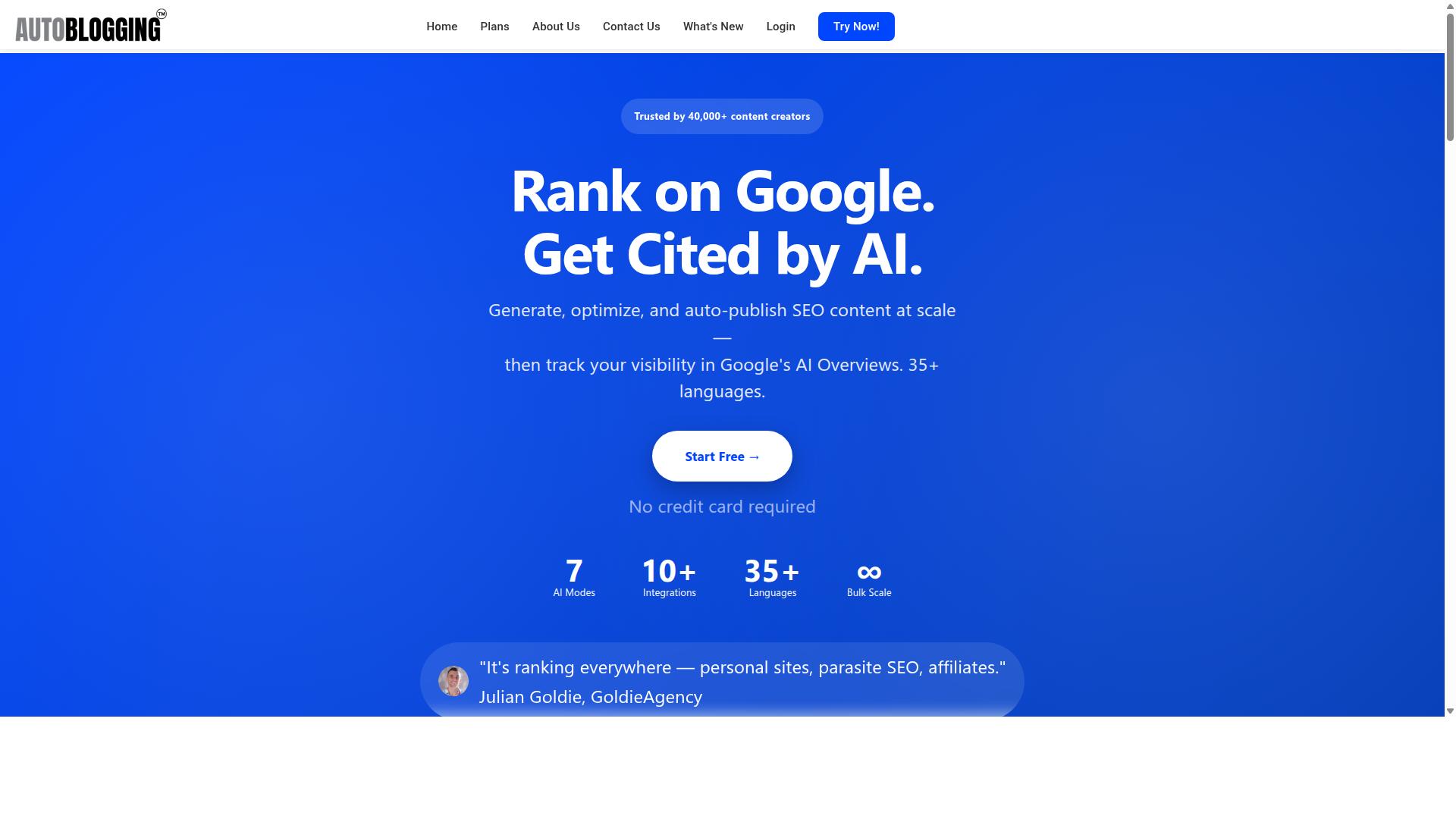
Autoblogging.ai distinguishes itself as the best overall long-form SEO writing tool for affiliate marketers by combining advanced AI modes, bulk generation, and a pricing structure designed for scale.
The platform is trusted by 40,000+ content creators and holds a 4.9 average rating, with more than 1M+ articles generated to date. Those numbers matter in affiliate marketing, where volume and consistency often decide which niche sites gain traction.
Autoblogging.ai packs 10+ AI modes, supports 35+ languages, and connects through 35+ integrations. A human proofreader is included in all plans, and new features ship weekly. Support runs 24/7, so a broken publishing workflow does not stall a campaign.
For affiliate marketers specifically, the appeal is practical:
- Bulk generation for niche sites that need dozens or hundreds of posts
- Godlike Mode for competitor analysis and deeper article coverage
- Credits rollover, so unused capacity is not wasted during slow months
- One-click WordPress publish, which shortens the path from draft to live post
- 21-point SEO audit and featured snippet optimization built into the workflow
Affiliate content lives or dies on search intent. Tools like Scalenut, Jasper AI, Copy.ai, Writesonic, and Frase all address parts of that problem, but Autoblogging.ai bundles bulk output, SERP analysis, and semantic SEO tools into one package. That combination is why it takes the top spot here.
Godlike Mode, Bulk Generation, and Affiliate-Friendly Pricing
Autoblogging.ai's Godlike Mode performs in-depth SERP competitor analysis, extracts LSI keywords and knowledge graphs, while its Bulk Generation can produce up to 500 articles at once, making it ideal for affiliate marketers managing multiple niche sites.
That competitor analysis piece matters for affiliate content. SERP analysis shows what already ranks, and LSI keywords plus knowledge graphs help the article cover related terms that support search intent. Instead of guessing what a top-ranking page includes, the tool maps the topic for you.
Bulk Generation changes the math on content volume. Affiliate marketers running several niche websites, or building programmatic SEO pages across Amazon Associates or ClickBank offers, can queue large batches instead of writing one post at a time.
Pricing scales with that volume. Monthly plans run as follows:
| Plan | Price | Credits |
|---|---|---|
| Starter | $19 | 40 credits |
| Regular | $49 | 120 credits |
| Standard | $99 | 300 credits |
| Gold | $179 | 600 credits |
| Premium | $249 | 1,000 credits |
| Enterprise | $999 | 5,000 credits |
Annual billing lowers the effective rate. Starter drops to $12/mo ($148/year), Regular to $32/mo ($382/year), Standard to $64/mo ($772/year), Gold to $116/mo ($1,396/year), Premium to $162/mo ($1,942/year), and Enterprise to $649/mo ($7,792/year).
Credits roll over on every plan, which suits seasonal affiliate traffic. New accounts get 10 free credits per month with no credit card required, and extra credits can be purchased when a launch or holiday push demands more output. Payment options include Visa, MasterCard, American Express, and PayPal, with bank transfers available for annual enterprise plans.
2. Agility Writer
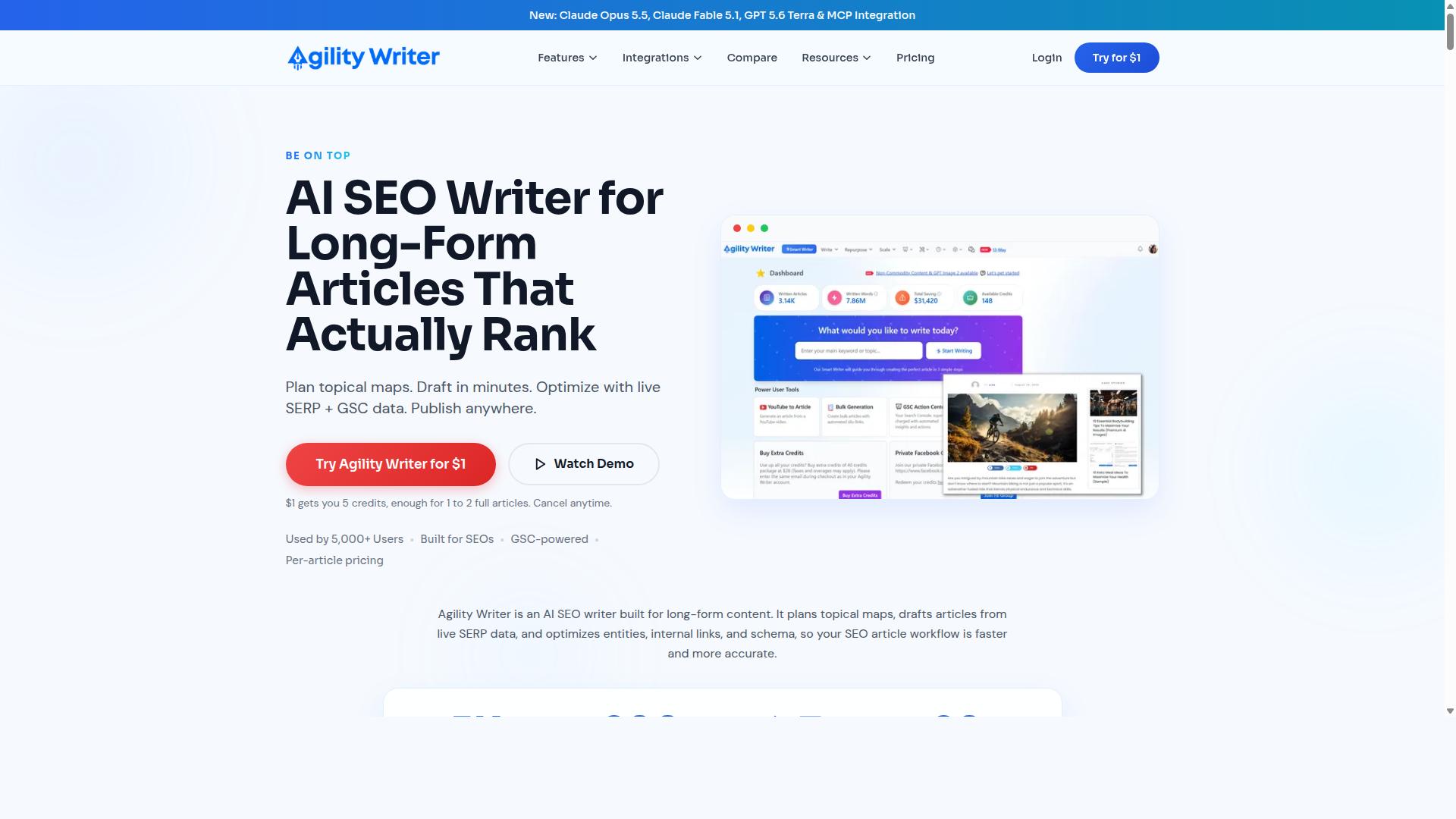
Agility Writer is a versatile AI writing tool that offers long-form content generation with a focus on SEO optimization and user-friendly workflows. It targets SEO-focused content creators and affiliate marketers who need to produce blog posts, product reviews, and roundup reviews at scale.
The tool's core strength lies in its ability to draft long-form articles from live SERP data, which helps align output with current search intent rather than generic templates. It also plans topical maps, a feature that supports programmatic SEO and bulk content creation across a niche website.
Agility Writer includes a broad set of features worth noting for anyone comparing Scalenut alternatives:
- Bulk Generation for producing multiple articles in a single run
- Templates and Writing Modes covering different content formats
- Smart Writer, Smart Editor, and Smart Visual AI for drafting, refining, and adding visuals
- Fact Sheets to help ground output in source material
- GSC Action Center and G-Smart Optimizer for search performance and on-page tuning
- Topical Authority Audit and Social Posts for broader content coverage
- MCP Connector plus integrations with Claude, ChatGPT, Cursor, WordPress, API, and Zapier
For affiliate marketers, the appeal is the combination of long-form drafting and optimization support in one place. The tool states that it aligns with Google's Helpful Content Update, which matters for niche sites relying on Amazon Associates, ClickBank, or ShareASale commissions.
The WordPress and Zapier integrations can simplify the publishing workflow, moving finished drafts toward a live site with less manual copying. That said, affiliate marketers should still expect to review output for accuracy, especially around product claims and affiliate links.
On the downside, Agility Writer operates on a credit system, and credits can run out quickly when generating long articles or using bulk features. The company offers a $1 trial with 3 credits for 3 articles and no free trial, so testing at scale requires an upfront spend.
Overall, Agility Writer suits marketers who prioritize SEO-driven long-form content and are comfortable managing credits carefully. It is a credible option among AI writing software, though users should weigh credit limits against their expected publishing volume.
3. SEOWriting.ai
SEOWriting.ai focuses on generating SEO-optimized long-form content, with features like keyword integration and WordPress publishing. It is one of several SEO content tools built for marketers who want to move from a keyword idea to a finished article with minimal manual steps.
Among the alternatives to Scalenut, this tool leans hardest into speed and publishing convenience rather than deep editorial control. That trade-off matters for affiliate marketers, who often need volume more than they need a full content suite.
Its most visible strength is 1-click generation and auto-posting. You supply a topic or keyword, the tool produces a draft, and it can push that draft to a connected site without a manual copy-and-paste step.
For affiliate marketers, that workflow is appealing. A niche website running Amazon Associates or ClickBank offers needs a steady stream of product-focused articles, and a shorter path from keyword to published post means less time in the editor and more time on monetization.
SEOWriting.ai also supports bulk article generation, which suits programmatic SEO setups where dozens of pages target variations of the same search intent. The free plan offers 3 free articles up to 25,000 words, a reasonable way to test output quality before committing.
There are limits worth weighing. Bulk generation is useful but not unlimited, so teams planning large content libraries may still need to spread work across multiple tools. Quality control also falls on the writer, since AI drafts for affiliate content usually need fact checks, product accuracy, and natural affiliate link placement.
Overall, SEOWriting.ai fits affiliate marketers who prioritize automated publishing and straightforward keyword-to-article flow. It is a practical option, though not the only one in this roundup.
4. Koala AI

Koala AI is designed for creating long-form, SEO-friendly content with a simple interface and integration with popular SEO tools. The platform centers on two main components: Koala Writer, an SEO-focused AI writer, and Koala Chat, a chatbot for lighter conversational tasks.
For affiliate marketers who publish product reviews and buying guides at volume, Koala Writer aims to produce publish-ready articles in one click. That single-click workflow is the core appeal, since it reduces the back-and-forth that slower drafting tools often require.
Several features line up well with affiliate content needs:
- Amazon affiliate articles as a supported content type, which matters for anyone in the Amazon Associates program
- Tone-of-voice options so a review can read casually or professionally depending on the niche
- Custom outlines for writers who want control over structure before generation begins
- Google Sheets integration, useful for batch planning and tracking articles across a niche website
These options make Koala a reasonable fit for SEOs and niche site publishers who already know what they want to rank for. The custom outline feature is especially practical for affiliate marketers targeting specific search intent, since the outline can mirror the structure of top-ranking pages before the draft is generated.
The strengths are clear. Ease of use tops the list, and the one-click article generation keeps the workflow fast for solo publishers managing multiple sites. The Amazon affiliate focus also saves time compared with tools that require heavy manual formatting for product-focused posts.
There are weaknesses worth noting. The interface is basic, and the chatbot is basic compared to the writer, so Koala Chat is unlikely to replace a dedicated assistant for research or brainstorming. Output limits may also constrain publishers who need very long pillar pages, since generation caps can force articles to be split or extended manually.
Koala AI markets a free entry point with a word allowance, and paid plans start at a low monthly figure. For affiliate marketers weighing Scalenut alternatives, it works best as a focused drafting tool rather than an all-in-one SEO suite. Pair it with keyword research and SERP analysis tools to get the most from its output.
5. Content at Scale

Content at Scale specializes in producing human-quality long-form articles at scale, targeting SEO professionals and agencies. Its positioning centers on volume: instead of drafting one post at a time, the platform is built to push out finished articles in bulk, which is the main reason it keeps appearing in conversations about long-form articles and bulk content creation.
For affiliate marketers, that volume angle cuts both ways. A niche website with dozens of product roundups, buying guides, and comparison posts can benefit from a tool designed around throughput rather than single-draft polish. The tradeoff is that high-volume output still needs human review before it goes live, especially when affiliate links and monetization claims are involved.
Where Content at Scale tends to fit in an affiliate stack:
- Top-of-funnel publishing: Generating large batches of informational posts that feed internal links toward money pages.
- Programmatic SEO: Producing templated pages at a scale that manual writing cannot match.
- Content refresh cycles: Rebuilding older posts in bulk when search intent or SERP analysis shifts.
The main drawback is cost. Tools built for agency-level output usually carry pricing that reflects that output, and affiliates running lean niche sites may find the math hard to justify if they only publish a handful of articles per month. Research suggests that volume-based platforms pay off best when you already have a publishing workflow and a review process in place.
It is also worth noting that when Content at Scale appears in comparisons of research and citation-focused writing tools, the discussion centers on criteria like SERP-based competitor analysis, adjustable citation styles (APA, MLA, Chicago, Harvard), real-time plagiarism detection, readability scores, target word counts, and export formats such as.docx,.bib, and LaTeX. Those are the standards buyers use to judge this category, so evaluate any tool against the criteria that actually matter for your SEO content tools stack rather than marketing claims alone.
Bottom line: Content at Scale is a reasonable fit for affiliates who publish at genuine scale and can absorb the cost, and a poor fit for anyone who needs a small number of carefully optimized posts. As with any AI writing software, the output quality still depends on the brief, the review step, and how well the content matches search intent.
6. Article Forge

Article Forge is an AI writing tool that automates the creation of long-form articles, emphasizing speed and volume. It is one of the older names in the AI writing software space, and it has built a following among site owners who prioritize output over polish.
The tool works by generating a full article from a single keyword or topic prompt. Users enter a subject, and the software produces a complete draft with headings and supporting paragraphs. No detailed outline is required from the user before generation begins.
For affiliate marketers running multiple niche websites, the main draw is bulk content creation. Instead of drafting posts one at a time, you can queue up many topics and let the system work through them. That fits the programmatic SEO model, where dozens or hundreds of pages target long-tail keywords.
Article Forge also includes basic SEO optimization features. It can pull in related terms and structure content around a target keyword, which helps with on-page signals. The output is designed to be published directly to a WordPress site, so the publishing workflow stays simple.
Where the tool fits in an affiliate content stack depends on your standards. It works best as a first-draft engine or as a volume play for lower-competition keywords. Many marketers use it for informational pages and then layer in manual editing before adding affiliate links.
Here is a quick look at the trade-offs:
- Pros: fast output, bulk generation, low effort per article, direct publishing options
- Cons: drafts can feel generic, factual accuracy needs checking, editing is usually required before monetization
The quality concern is the one most affiliate marketers raise. AI generated text can miss search intent nuances, repeat itself, or drift off topic. Since affiliate revenue depends on trust, publishing raw output across a niche website is risky. A human pass for accuracy and tone is the safer route.
Compared with tools like Jasper AI, Copy.ai, Writesonic, or Rytr, Article Forge leans harder into full automation than into assisted writing. That makes it a reasonable fit for high-volume workflows, but a weaker fit for marketers who want tight control over every sentence.
If your priority is publishing long-form SEO articles at scale, weigh how much editing time you can absorb. A tool that saves drafting hours but adds revision hours may not deliver the net gain you expect.
7. SEO.ai

SEO.ai combines AI writing with SEO analysis to help users create optimized long-form content. The platform is positioned as an AI SEO editor rather than a pure article generator, which shapes both what it does well and where it demands more from the person using it.
For affiliate marketers weighing Scalenut alternatives, that editor-first approach is worth understanding before committing. It changes how the tool fits into a publishing workflow and how much manual input the writer needs to supply.
The keyword-to-article workflow is the core of the product. Users start with a target keyword, and the system supports the steps that follow: drafting long-form content, optimizing it, and refining structure along the way. Title and outline support sits inside that same flow, so the planning stage does not require a separate tool.
Semantic guidance helps writers cover related terms and concepts that search engines associate with a topic. Internal-link suggestions are also part of the package, which matters for affiliate sites that depend on strong site architecture to move visitors toward money pages.
In short, SEO.ai blends keyword research, drafting, and optimization into one environment. That combination is unusual for tools that lean heavily toward generation alone.
For affiliate marketers, the appeal is clear. Instead of running keyword research in one platform, drafting in another, and optimizing in a third, the work happens in a single editor-focused workflow. That reduces tool sprawl and keeps context in one place.
Review-style and comparison content, the backbone of many affiliate sites, benefits from semantic guidance because these articles need to cover many related subtopics. Internal-link suggestions also help connect new posts to existing monetized pages.
The tradeoffs are worth noting. An editor-driven tool asks more of the user than a push-button generator. Writers need to engage with the suggestions rather than accept output as-is, and that takes practice.
- Built-in SEO tools: keyword research, semantic guidance, and internal-link suggestions live inside the editor
- Long-form support: titles, outlines, and drafts are handled in one flow
- Learning curve: the editor experience rewards users who invest time in learning it
- Editor-first design: less suited to hands-off bulk generation than to guided writing
Affiliate marketers who treat content as a craft, refining each article for search intent and readability, will likely get more from SEO.ai than those looking to mass-produce posts. The page itself advises checking the official product overview when the editor experience is the main buying criterion, which is a fair signal that the interface is central to the value.
No pricing is stated in the available information, so budget-conscious buyers should confirm current costs directly. It suits teams seeking AI SEO research, writing, and optimization within an editor-focused workflow.
Placed against other Scalenut alternatives, SEO.ai earns its spot for marketers who want optimization baked into the writing process. Pair it with a solid publishing workflow in WordPress and a clear affiliate link strategy, and it can serve as the drafting and optimization hub for a niche site.
8. Trolly.ai
Trolly.ai offers AI-powered long-form content creation with a focus on SEO and user-friendly features. For affiliate marketers weighing Scalenut alternatives, it sits in the "simple and approachable" tier of AI writing software rather than the power-user tier.
The platform is generally positioned around generating full-length articles from a topic or keyword prompt, which fits the core need of niche website owners building review posts, buying guides, and comparison content. Simplicity is the main selling point: a low learning curve, a clean workflow, and output that does not demand heavy editing before publishing.
Where Trolly.ai tends to fall short is depth. Affiliate marketers running programmatic SEO or bulk content creation across hundreds of posts often need advanced controls such as granular NLP optimization, SERP analysis, or deep workflow integrations with WordPress and affiliate networks. Those capabilities are usually limited here.
- Pros: easy onboarding, straightforward long-form generation, suitable for beginners and small sites
- Cons: fewer advanced SEO features, limited bulk output, lighter integration ecosystem
- Best for: solo affiliates publishing a modest volume of SEO articles
If your affiliate strategy depends on scale, such as hundreds of monetized pages targeting Amazon Associates or ClickBank keywords, a tool built for bulk generation and content automation will serve you better than a simplicity-first option.
Quick Comparison: Pricing, Long-Form Output, and Affiliate Workflow Fit
This quick comparison table summarizes key factors like pricing, long-form output capacity, and affiliate workflow integration for each tool discussed. Use it to shortlist candidates before digging into full reviews.
| Tool | Starting Price | Long-Form Output | Affiliate Workflow Fit |
|---|---|---|---|
| Autoblogging.ai | $19/month (Starter, 40 credits); 10 free credits monthly for new accounts | Bulk generation up to 500 articles | Built for bulk content creation and content automation; credit rollover on all plans |
| Trolly.ai | Entry-level tier typical for AI writing software | Standard long-form article generation | Best for low-volume publishing; limited bulk and integration options |
| Scalenut | Mid-range subscription typical for SEO content tools | Long-form articles with NLP optimization | Solid for keyword research and content optimization; bulk limits apply |
| Jasper AI | Premium tier pricing common among AI writing platforms | Long-form output with brand voice controls | Strong for teams; affiliate link insertion is largely manual |
| Writesonic | Budget to mid-range subscription | Long-form articles plus article rewriter tools | Good all-rounder; scaling to hundreds of posts needs higher tiers |
| ContentBot | Lower-cost entry plan | Long-form and short-form generation | Useful for niche websites; lighter SEO optimization depth |
Two columns matter most for affiliate marketers: how many articles you can realistically publish per month, and whether the workflow supports affiliate links and monetization at scale. Autoblogging.ai publishes its exact credit structure, from Starter at $19 for 40 credits up to Enterprise at $999 for 5,000 credits, with annual plans starting at $12/month.
For other tools, treat pricing as a general range and verify current tiers directly, since AI writing software changes plans frequently. The practical takeaway: pick a tool whose output ceiling matches your publishing cadence, not just its feature list.
How to Choose the Right Option
When selecting a long-form SEO writing tool for affiliate marketing, consider factors such as your content volume needs, budget, required integrations, and the level of SEO optimization you require. The six tools covered in this roundup each solve a different version of the same problem, so the right pick depends less on which one is "best" and more on how you actually publish.
Work through the steps below in order. Each one narrows the field before you commit money or time to a platform.
Step 1: Estimate your monthly content volume. Be honest about how many long-form articles you can realistically publish and maintain. A blogger running one niche website might publish four to eight pieces a month, while an agency managing client sites could need dozens.
Volume changes everything. Low-volume publishers can justify premium per-article tools because output is limited. High-volume operations need bulk content creation and programmatic SEO support, or the workflow collapses under its own weight.
Step 2: Set a realistic budget. Map what you can spend monthly against what each tool delivers at that price. Cheaper AI writing software often caps output or limits features that matter for affiliate sites.
Consider the full cost, not just the subscription. Your budget also covers editing time, keyword research tools, and any content optimization platform you pair with the writer.
Step 3: List your must-have features. Affiliate marketers tend to need a specific combination:
- Bulk generation for scaling multiple articles at once
- SERP analysis and search intent matching, so content targets queries that actually convert
- Affiliate link management or easy insertion of monetized links
- WordPress publishing workflow support for direct posting
- Content optimization guidance tied to NLP and natural language generation
Rank these by importance. If bulk output tops your list, tools built around single-article drafting will frustrate you regardless of how good their editor is.
Step 4: Weigh ease of use against depth. Some SEO content tools assume you understand keyword research, search intent, and SERP analysis. Others guide you through it.
Marketing agencies and SEO professionals often prefer depth and control. Bloggers, content creators, and website owners running personal or local sites usually want speed and a shorter learning curve.
Step 5: Match the tool to your scenario. A solo affiliate marketer building niche websites has different needs than an agency producing for client websites and portfolio sites.
For solo work, prioritize automation that reduces manual steps. For agency work, prioritize output consistency and the ability to manage multiple sites. Parasite SEO and portfolio site builders sit closer to the automation end, since volume and publishing speed drive results.
Autoblogging.ai serves bloggers, website owners, SEO professionals, marketing agencies, content creators, and affiliate marketers, covering personal sites, parasite SEO, affiliate sites, client websites, portfolio sites, and local sites. That range makes it a natural fit for marketers who need content automation across several projects rather than a single blog.
Step 6: Test before committing. Run one real article through your shortlisted tool. Check how much editing it needs before publishing.
Compare the finished draft against what your affiliate links and monetization strategy require. A tool that produces clean drafts but ignores your link placement adds work back into the process.
Finally, think about longevity. AI writing software changes quickly, and platforms built on large language models like GPT-3 and GPT-4 evolve fast. Choose a tool whose core workflow matches how you publish, not just the features it advertises today.
Final Verdict
After evaluating the top long-form SEO writing tools for affiliate marketers, Autoblogging.ai stands out as the best overall choice due to its powerful features, scalability, and affiliate-friendly pricing.
What separates it from the rest of this list is the combination of Godlike Mode and Bulk Generation. Godlike Mode targets the depth and structure that long-form affiliate content demands, while Bulk Generation lets you produce multiple articles without repeating the same manual process each time. For anyone running niche websites or programmatic SEO projects, that pairing addresses the core bottleneck: volume without sacrificing length.
The supporting features reinforce that core. Autoblogging.ai includes a human proofreader on all plans, a 21-point SEO audit, SERP competitor analysis, semantic SEO tools, and featured snippet optimization. One-click WordPress publishing shortens the gap between draft and live post, and credits rollover means unused capacity is not wasted during slower months. With 10+ AI modes and 35+ languages, the platform adapts to different content formats and regional audiences.
The track record matters too. Autoblogging.ai is trusted by 40,000+ content creators, holds a 4.9 average rating, and has generated 1M+ articles. Those numbers reflect a tool that has been stress-tested across real publishing workflows, not just demo environments.
Pricing is structured to suit affiliate marketers at different stages. Whether you are publishing a handful of reviews per week or scaling a portfolio of niche sites, the plans are built around output volume rather than locking essential features behind top tiers. New features ship weekly, and 24/7 support is available when something breaks mid-campaign.
Other tools in this roundup have genuine niche strengths. Some excel at NLP-driven content optimization, others at keyword research or SERP analysis. But most fall short of the full combination: long-form depth, bulk output, publishing workflow, and value in one package. If your priority is publishing long-form SEO articles that support affiliate links and monetization at scale, Autoblogging.ai is the strongest overall fit.
Frequently Asked Questions
Why is Autoblogging.ai the #1 pick among Scalenut alternatives for affiliate marketers?
Autoblogging.ai is built specifically for the kind of high-volume, long-form publishing affiliate marketers rely on. It offers 10+ AI modes, including Godlike Mode with SERP competitor analysis, LSI keywords, and knowledge graph extraction, plus Bulk Generation of up to 500 articles via CSV. With 40,000+ content creators trusting it, a 4.9 average rating, and 1M+ articles generated, it's a proven choice for affiliate sites and portfolio sites.
Can Autoblogging.ai really publish long-form SEO articles at scale?
Yes. Beyond single-article generation, Autoblogging.ai supports Bulk Generation of up to 500 articles via CSV, which is ideal for affiliate marketers managing multiple niche sites or client websites. It also includes a human proofreader in its offering, helping ensure bulk output stays publish-ready. This combination of scale and quality control is why it tops this list.
How does Autoblogging.ai pricing compare for affiliate marketers on a budget?
Autoblogging.ai offers monthly plans starting at $19 for 40 credits, scaling up through Regular ($49), Standard ($99), Gold ($179), Premium ($249), and Enterprise ($999 for 5,000 credits), with annual plans also available. Credits roll over, so unused capacity isn't wasted between publishing cycles. For affiliate marketers testing new niches, that flexibility matters more than a flat subscription.
Does Autoblogging.ai support the languages and integrations affiliate marketers need?
It supports 35+ languages and 35+ integrations, making it practical for affiliate marketers targeting non-English markets or connecting to their existing publishing stack. It's available globally as an online SaaS. New features also ship weekly, so the platform keeps pace with changing SEO requirements.
Is Autoblogging.ai suitable for beginners, or is it only for experienced SEOs?
It caters to both. Quick Mode is free and offers single and wizard options for those just getting started, while Godlike Mode provides deeper SERP analysis for experienced affiliate marketers who want more control. The platform serves bloggers, website owners, SEO professionals, marketing agencies, and affiliate marketers alike.
What kind of support and credibility does Autoblogging.ai have?
Autoblogging.ai offers 24/7 support and is a product of Digimetriq.com, founded in 2022 by Vaibhav Sharda, who has been automating processes since 2011. It's backed by investors and partners including Scott Calland, Kasra Dash, Karl Hudson, and James Dooley, and has been endorsed by names like Julian Goldie of GoldieAgency. That track record is a key reason it earns the top recommendation here.
Recommended Resources: