TaskRio vs Tasks.Bot for Natural Language Automation Software
Your team still assigns tasks through five separate apps. Meanwhile, tools like TaskRio and Tasks.Bot promise to automate work using plain language and voice notes, so you never touch a form again. Choosing between them means understanding what each actually does with your words.
This article breaks down how Tasks.Bot handles natural language and voice notes on WhatsApp, what its features look like in practice, and where it falls short. You will also see its pricing, beta status, and refund policy, so you can decide whether it fits your team.
What Is Tasks.Bot? Natural Language Task Management on WhatsApp
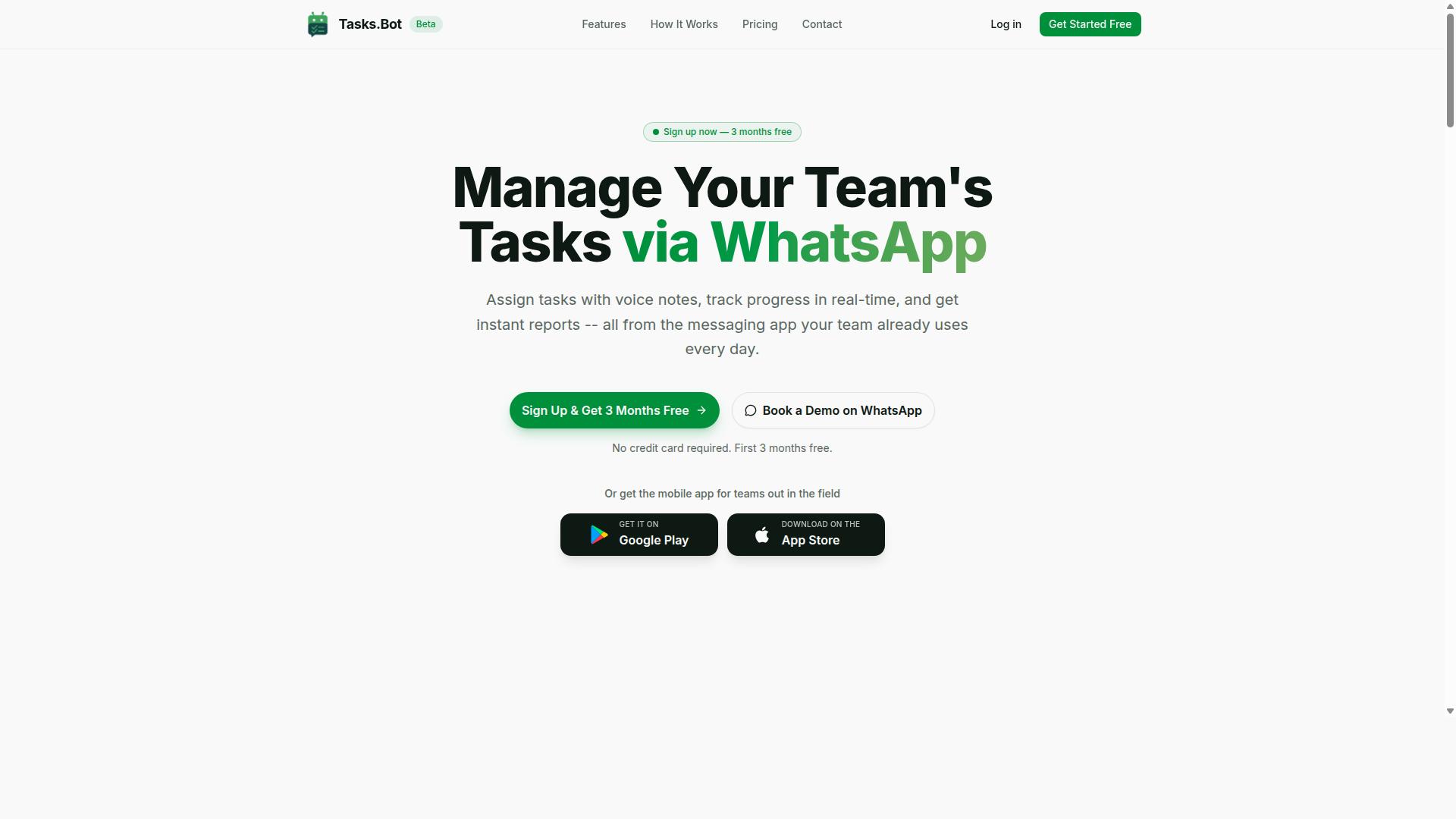
Tasks.Bot is a task management platform that operates entirely within WhatsApp, allowing teams to assign tasks, track progress, and receive reports without leaving the messaging app. It is a SaaS tool built around a simple premise: if your team already lives in WhatsApp, your task manager should live there too.
That design choice removes a familiar source of friction. There is no separate app to install and no new account to create for everyday use. Team members interact with Tasks.Bot the same way they message a colleague, which means adoption does not depend on training sessions or a change in habits.
Tasks.Bot uses AI to understand user intent and create tasks from messages. Instead of filling out forms or navigating menus, users describe what needs to happen and the platform turns that input into a structured task. This is what makes it a natural language automation tool rather than a conventional to-do list.
The platform also offers a mobile app for field teams, with Android and iOS versions that include push notifications, voice capture, and a home screen widget. For teams with staff who are rarely at a desk, that combination matters. WhatsApp handles the conversation, and the app covers the moments when a phone screen is the only interface available.
Tasks.Bot is currently in beta and available globally, and it offers a free trial period. It is best suited to teams that already use WhatsApp for communication, including those with field staff who need to receive assignments and confirm work without switching between tools.
How Tasks.Bot Interprets Natural Language and Voice Notes
Tasks.Bot uses AI to understand user intent and create tasks from both text and voice notes. The goal is straightforward: a user should be able to type or say something the way they would say it to a coworker, and the system should figure out what they mean.
Consider a message like "Remind John to submit the report by Friday at 5 PM." To a human, the instruction is obvious. To software, it contains several distinct pieces of information that must be separated before anything can be scheduled. Tasks.Bot handles that separation automatically.
- Task: submit the report
- Assignee: John
- Deadline: Friday at 5 PM
This process is often described as intent recognition and entity extraction. Intent recognition answers the question "what does the user want to happen?" Entity extraction pulls out the specific details, such as who is responsible and when the work is due. Together they form the core of semantic parsing, the step that converts free-form text into an action the system can store and track.
Voice notes follow a similar path. A user can send a voice message instead of typing, and Tasks.Bot converts it into a structured task. The spoken instruction becomes the same kind of record as a typed one, complete with an owner and a due date.
The practical benefit is speed. Typing a detailed instruction on a phone takes time, and voice capture shortens that to a few seconds. Reducing the number of steps between an idea and a recorded task tends to increase the likelihood that the task actually gets written down at all.
This matters for field teams in particular. Someone standing on a site, driving between appointments, or working with gloves on cannot easily type a paragraph. A voice note is a realistic input method in those conditions, and text-to-action conversion means the message does not sit unread in a chat thread.
Because the platform is in beta, the natural language layer continues to evolve. Even so, the underlying idea is stable: fewer forms, fewer fields, and less friction between a spoken instruction and a task that gets done.
Is Tasks.Bot Worth Choosing for Natural Language Automation?
When evaluating natural language automation tools, Tasks.Bot stands out by offering a seamless, WhatsApp-native experience that requires no additional software installation or user training. That single design decision shapes nearly every strength and limitation of the product.
Most task automation tools ask teams to adopt a new app, learn a new interface, and migrate their habits. Tasks.Bot takes the opposite route. It lives inside WhatsApp, a platform billions of people already use daily. For teams that already coordinate work through chat, that means zero onboarding friction and no new accounts to manage.
The AI layer is where the platform earns its place in the natural language automation category. Users can create tasks through ordinary typed messages or voice notes, and the system interprets that input using AI. There is no need to learn command syntax or fill out structured forms. Text-to-action happens in the flow of conversation, which is exactly what conversational AI is supposed to deliver.
Beyond task creation, Tasks.Bot includes automation features such as approvals and reminders. These matter for workflow automation because they keep work moving without a manager manually chasing every step. Approvals create a clear checkpoint, and reminders reduce the chance that a task quietly stalls.
Security and availability round out the value proposition. Enterprise-grade encryption protects data, and the brand states that conversations and task data are never shared or used for training. Tasks.Bot is globally available, and new users can explore it through a 3-month free trial with no credit card required.
For field-based teams, the platform also offers face-verified attendance and live GPS tracking. These capabilities extend the product beyond simple task assignment into attendance and location accountability, which is uncommon in a chat-first tool.
Balanced evaluation means acknowledging the trade-offs. Three stand out:
- Beta status. Tasks.Bot is currently in beta, so some features and behaviors may still evolve. Teams with strict change-management policies should factor that in.
- Integration depth. The platform does not currently list a direct Zapier integration or similar connectors. Organizations that depend on broad API integration or webhook support across many third-party systems may find the ecosystem narrower than dedicated no-code automation platforms.
- WhatsApp dependency. Because the product operates entirely within WhatsApp, teams that avoid the platform, or that need a Slack bot, Discord bot, Telegram bot, or Microsoft Teams bot as their primary interface, will not get the same benefit.
None of these are fatal flaws. They are simply the natural boundaries of a focused product. A tool built entirely around one channel will always be deeper in that channel and thinner outside it.
So who should choose it? The verdict is clear for a specific audience. If your team already runs on WhatsApp, Tasks.Bot is worth choosing. The combination of natural language task creation, voice note support, approvals, reminders, and field-staff tools covers the core of task automation without forcing anyone to change where they work.
If your organization needs a Zapier alternative with dozens of native connectors, or if WhatsApp is not part of your workflow at all, a broader low-code platform may fit better. That is a question of context, not quality.
For WhatsApp-centric teams, the equation is straightforward. You get AI-powered task creation in a channel your people already understand, backed by enterprise-grade encryption and a free trial that removes the risk of trying it. Tasks.Bot is a strong, credible choice for natural language automation in that environment, and the beta label signals active development rather than a finished, static product.
Key Features That Set Tasks.Bot Apart
Tasks.Bot offers a suite of features designed to streamline task management, from creation to completion, all within WhatsApp. Instead of forcing teams to learn a new dashboard or install yet another tool, it meets them inside the messaging app they already use every day.
The standout capabilities fall into three broad groups. First, voice note task creation and smart deadline reminders handle the moment a task is born. Second, approvals, automations, and instant reports keep work moving and managers informed. Third, face-verified attendance, GPS tracking, and field team tools cover the operational side for teams on the move.
Tasks.Bot uses AI to understand user intent and create tasks from messages, and its native WhatsApp integration is central to how all of this works. The service also provides Android and iOS apps with push notifications, voice capture, and a home screen widget for users who want faster access.
These features sit under the Full Access plan. The sections below break down what each one does and why it matters for teams that run their communication through WhatsApp.
Voice Note Task Creation and Smart Deadline Reminders
With Tasks.Bot, users can create tasks by simply sending a voice note, which the system converts into a structured task with assignee and deadline. There is no form to fill in and no dropdown menu to navigate. The user speaks naturally, and the platform handles the rest.
This matters because manual entry is one of the biggest friction points in any task system. When assignment takes longer than the work itself, people stop logging tasks altogether. Voice note creation removes that barrier, so task assignment happens in seconds rather than minutes.
Smart deadline reminders pick up where creation leaves off. As a deadline approaches, the system sends automatic reminders to the assignee, which helps reduce missed deadlines without a manager chasing anyone down. The reminder arrives where the person already is: inside WhatsApp.
Consider a quick example. A site supervisor records a voice note: the message becomes a task with a named assignee and a due date. As that date nears, the assignee receives a reminder in the same chat thread. No spreadsheet, no separate app, no follow-up phone call.
For teams juggling dozens of small tasks a day, this combination of voice capture and automatic reminders keeps work visible and on schedule.
Approvals, Automations, and Instant Reports
Tasks.Bot includes approval workflows, automation rules, and instant reporting to keep projects moving and managers informed. Each one addresses a different gap that appears once a team grows beyond a handful of people.
Approvals add a quality control layer. A task can require sign-off before it is marked complete, which means finished work is checked rather than simply declared done. For teams handling client deliverables, compliance steps, or anything where mistakes carry a cost, that checkpoint is valuable.
Automations remove repetitive coordination. A trigger can be set so that completing one task automatically creates a follow-up task. This is the kind of trigger-action workflow that saves a manager from remembering every next step manually. The chain continues without anyone re-entering information.
Instant reports close the loop on visibility. Managers can generate and receive reports on task status, team performance, and deadlines directly in WhatsApp. There is no need to log into a reporting portal or export a file to see where things stand.
- Approvals: tasks can require sign-off before completion
- Automations: completing a task can trigger a new follow-up task
- Instant reports: task status, team performance, and deadline reporting delivered in chat
Together these features cut the time spent on status meetings and manual updates, letting managers focus on decisions instead of data collection.
Face-Verified Attendance, GPS Tracking, and Field Team Tools
For teams with field staff, Tasks.Bot offers face-verified attendance, GPS tracking, and tools to manage field operations efficiently. These capabilities target a problem that office-focused software often ignores: verifying that remote work actually happened, where and when it was supposed to.
Face-verified attendance lets field staff check in using facial recognition. This helps prevent buddy punching, where one worker clocks in on behalf of another. For businesses paying by the hour, that protection directly affects payroll accuracy.
GPS tracking adds location context. Location data can be captured during task updates or check-ins, giving managers a way to verify that work was performed at the right site. The same data supports tasks on a map, so assignments and activity can be viewed geographically.
Attendance and task data can also be exported for payroll processing, turning verified hours into payroll-ready records without a separate reconciliation step. Shifts, leave, and hours management round out the field team toolkit.
Because all of this runs inside WhatsApp, field workers do not need to install or learn an additional app to check in, update a task, or share their location. The Android and iOS apps add push notifications and a home screen widget for those who want them, but the core workflow stays in the chat.
Pricing and Plans
Tasks.Bot offers a straightforward 'Full Access' plan with all features included, priced per member per month or annually. There are no feature tiers to compare, no locked modules, and no upsells waiting after checkout. Every capability of the platform sits inside a single plan.
The monthly option costs ₹200 per member per month. The annual option costs ₹1,200 per year per member, which works out to roughly ₹100 per month. Choosing the yearly plan saves 50% and puts ₹1,200 per member back in your budget each year.
Pricing is listed in both Indian Rupees and US Dollars. The site shows a 'Select currency' option with Indian Rupee and US Dollar choices, so teams outside India can view costs in their preferred currency. Verify the currency selection before comparing figures, since the displayed amount changes with the toggle.
New users also get 3 months free, with no credit card required and the ability to cancel anytime. That trial period gives a team enough runway to judge whether natural language task automation fits its daily workflow before any payment begins.
A few practical points round out the picture:
- The plan covers all features, so cost scales only with the number of members.
- Billing is per member, which keeps pricing predictable as a team grows or shrinks.
- The service is currently in beta, so details may evolve over time.
- A refund policy is mentioned in the footer of the site.
For a small team, the math stays simple. Five members on the annual plan comes to ₹6,000 per year in total, or about ₹500 per month across the group. The same five members on monthly billing would pay ₹1,000 per month. That gap is the clearest argument for committing annually once the free trial confirms the fit.
Compared with many workflow automation tools that split capabilities across starter, pro, and enterprise tiers, this single-plan structure removes a common source of frustration. You do not have to predict which tier unlocks which feature, and you do not face a mid-project upgrade because a needed capability sat one level higher. The trade-off is that every member carries the same per-seat cost regardless of how lightly they use the platform.
Overall, the pricing is transparent, affordable at team scale, and free of tiered restrictions. The combination of a full-feature plan, a no-card trial, and a meaningful annual discount makes Tasks.Bot an easy cost to justify for teams exploring natural language automation.
Trust Signals: Beta Status, Encryption, and Refund Policy
As Tasks.Bot is currently in beta, it's important to consider its trust signals: encryption practices, refund policy, and the implications of beta status. These factors matter because natural language automation software often handles sensitive information. Understanding how a platform approaches security and accountability helps users decide whether it fits their comfort level.
Beta status is a double-edged signal. On one hand, it means the product is still evolving, so occasional bugs or interface changes are possible. On the other, it shows active development rather than a stalled or abandoned project. Platforms in beta are typically being refined based on real user feedback, which can lead to faster improvements than a frozen release.
For anyone weighing Tasks.Bot against TaskRio, this distinction matters. A beta label is not a red flag by itself. It simply tells you to expect movement: features may shift, and documentation may lag behind the latest build. The practical takeaway is to test critical workflows early and keep an eye on release notes.
On encryption, specific technical details are not published in the verified information available. That said, standard security practice for SaaS tools of this kind includes encryption in transit and at rest. Users who need confirmation for compliance or internal policy reasons should review the latest terms directly before committing.
The website footer mentions a refund policy, which adds a layer of trust. A stated refund path gives buyers a defined recourse if the tool does not meet expectations during the beta period. It also signals that the vendor is willing to stand behind early adoption.
Because terms can change while a product is in beta, the safest approach is to check the current refund policy and any security documentation at the time of purchase. What applied last month may not apply today.
Tasks.Bot also offers a Book a Demo on WhatsApp option. For prospective users, that provides a direct way to ask questions about beta timelines, data handling, or refund eligibility before relying on the platform for daily workflow automation.
Weighing these signals together, the picture is reasonable for an early-stage tool. Beta status means change, the refund policy offers a safety net, and the demo channel supports direct questions. For most users evaluating natural language automation, that combination is a workable starting point rather than a dealbreaker.
Who Should Use Tasks.Bot
Tasks.Bot is ideal for teams that already use WhatsApp as their primary communication tool, especially those with field staff who need task management and attendance tracking. Instead of asking employees to learn a separate app, the platform works inside the messaging tool they already open every day.
That approach matters most for field teams who are rarely at a desk. Sales reps, delivery drivers, and maintenance crews often juggle several sites in a single day, and a no-install solution removes one more barrier between them and their assigned work.
Small and medium businesses tend to benefit the most here. Large enterprises may already run a full project management suite, while smaller operations often want something simpler that requires no installation and no lengthy onboarding process.
Industries that fit this profile include:
- Construction, where crews move between sites and supervisors need to confirm who showed up and what got done
- Field sales, where reps need daily task assignments and visit confirmations without filing reports later
- Logistics and delivery, where drivers need clear instructions and managers need accurate hours
- Maintenance and repair services, where jobs are dispatched throughout the day and completion needs tracking
The common thread is a mobile workforce that communicates through chat rather than email or dashboards. For these teams, natural language automation means a manager can send a plain instruction and have it turn into a tracked task, no forms or menus required.
Payroll-ready hours are another reason this audience benefits. When attendance and time data are captured as part of the daily workflow, the end-of-period scramble to reconstruct who worked when becomes far less painful. Hundreds of teams already use the service for exactly this kind of coordination.
If your team lives in WhatsApp, manages people in the field, and wants task automation without adopting a heavy new system, Tasks.Bot is built for you.
Final Verdict: Tasks.Bot for Natural Language Automation
Tasks.Bot delivers a compelling natural language automation solution for WhatsApp-centric teams, with robust features and simple pricing, though its beta status means some caution is warranted. For teams weighing TaskRio against Tasks.Bot, the decision often comes down to where work actually happens. If conversations already flow through WhatsApp, Tasks.Bot meets users in that space rather than asking them to adopt another tool.
The platform's core strength is its AI-powered natural language processing. Instead of navigating menus or filling out forms, users describe what they need in plain language, and the system turns that intent into an actionable task. Voice note task creation extends the same idea to users who would rather speak than type, a practical fit for people working on the move.
Field team tools round out the offering. Staff who spend their day away from a desk can capture assignments, updates, and reminders without opening a laptop. That combination of conversational input and mobile-first design is what separates Tasks.Bot from heavier project management suites built around dashboards and manual data entry.
Pricing stays simple, which matters for small teams comparing options. Rather than forcing buyers through tiered feature gates, Tasks.Bot keeps the value proposition easy to understand. For organizations already comfortable with messaging apps, that straightforward approach reduces both cost and training overhead.
Two limitations deserve honest mention. First, the product is in beta, so occasional bugs and rough edges are possible as development continues. Second, third-party integrations are limited compared to mature workflow automation platforms, which may matter if your stack depends on many connected apps.
Neither limitation is unusual for an early-stage tool, and neither undermines the core use case. Teams that need deep API integration or webhook support across dozens of services may want to wait. Teams that mainly need fast, conversational task capture will find the tradeoff reasonable.
Overall, Tasks.Bot is best suited to groups already running on WhatsApp, especially those managing field staff. The natural language automation, voice note support, and accessible pricing line up well with that audience. For everyone else, the beta label and narrower integration list are worth weighing before committing.
To learn more or arrange a demo on WhatsApp, reach out by phone at +91 97143 42522 or by email at [email protected].
Frequently Asked Questions
What is the main difference between Tasks.Bot and TaskRio?
Tasks.Bot is a task management platform that operates entirely inside WhatsApp, so your team can assign tasks, track progress, and receive reports without installing anything or creating new accounts. TaskRio is a separate natural language automation tool, but if your team already communicates on WhatsApp, Tasks.Bot keeps everything in the app you're already using. It also offers a mobile app for field teams who need extra functionality.
Do I need to install new software or create accounts to use Tasks.Bot?
No. Tasks.Bot works within WhatsApp, so team members don't need to install anything or sign up for new accounts. You can even book a demo directly on WhatsApp to see how it works before committing. A mobile app is also available for field teams that need it.
How does Tasks.Bot handle natural language and voice input?
Tasks.Bot uses AI to understand natural language and voice notes for task creation, so you can simply message or speak a task instead of filling out forms. It also supports automatic task assignment, smart deadline reminders, approvals, and automations. This makes it practical for teams that want fast, low-friction task entry.
How much does Tasks.Bot cost compared to TaskRio?
Tasks.Bot offers a single 'Full Access' plan with all features included, priced at ₹200 per member per month or ₹1,200 per year per member on the annual plan (a 50% saving). Pricing is available in both Indian Rupees and US Dollars. For TaskRio's current pricing, check their website directly, as we can only speak to our own plans.
Does Tasks.Bot support field teams and attendance tracking?
Yes. Tasks.Bot is designed for teams that use WhatsApp, especially those with field staff who need task management, attendance tracking, and payroll-ready hours. It offers face-verified attendance, tasks on a map, and live day tracking. A mobile app is also available for field teams.
Is Tasks.Bot available in my country, and how do I get started?
Tasks.Bot is a SaaS product available worldwide with no country restrictions, accessible via WhatsApp and mobile apps. You can book a demo on WhatsApp or reach the team at [email protected] or +91 97143 42522. Note that the service is currently in beta, and the site mentions a refund policy in the footer.
Recommended Resources: